
Legacy
We are older now. It is the simplest way to say the thing that is harder to admit. My wife turned fifty a few days ago — a milestone in the ways numbers mark our lives like rings inside a cut tree. I passed that line a few years ago, and together we stand on a ridge with the landscape of our past spread wide behind us. Childhood. Young marriage. Children small enough to carry asleep from the car to the bed. All the noise and longing and ordinary Tuesday evenings. Most of it gone the way things go: quietly, even beautifully, like mist when the sun rises.
I married her when she was nineteen. A number that sounds reckless and romantic only when spoken in hindsight. At nineteen you think life is an open ledger of possibility, pages clean and endless. You believe you have time to write everything worth saying. And perhaps that is the first illusion I held. The idea of time as something bankable, renewable, something you can spend freely and earn back later.
Now we wake in a house we built with our own imperfect hands, metaphorically if not with literal lumber. The children are grown. The photos show us thinner, unlined, careless with time in a way that feels almost obscene now. Joan Didion once wrote, “Life changes fast. Life changes in an instant. You sit down to dinner and life as you know it ends.” She was speaking of grief, but the line applies too to the slow grief of aging. The way a decade can vanish like a dropped stitch in a sweater.
We are not old, not yet. But we are no longer young. We live in the paradoxical middle-country where the future is still possible but no longer guaranteed.
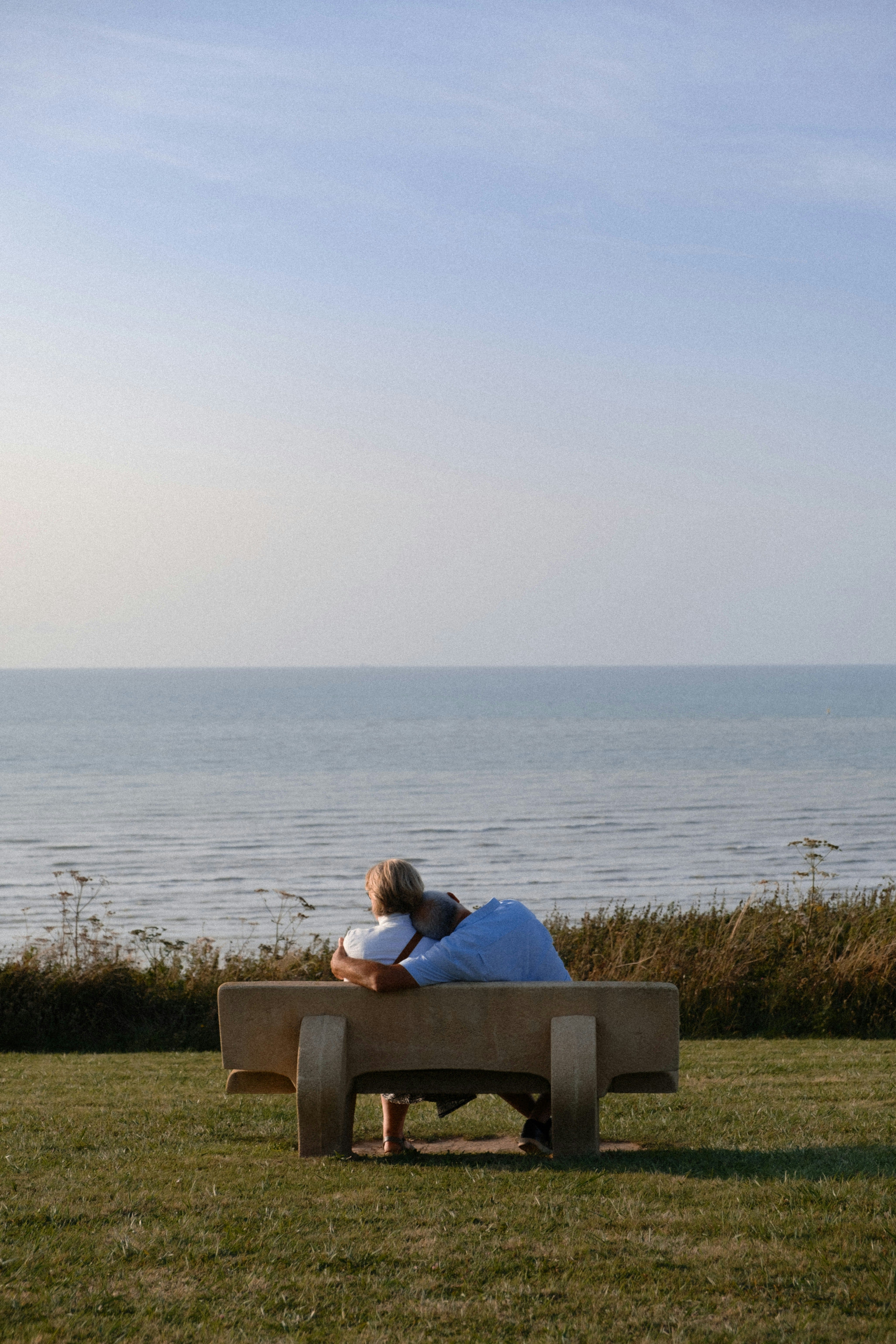
I do not know when I first realized that we likely have fewer days ahead than behind. Perhaps it was the morning after my fiftieth birthday, when the cake was half eaten and the house strangely still. Or the night I caught my reflection unexpectedly, eyes tired, shoulders stooped from work, and thought, It happened. I aged.
In youth we imagine legacy as a monument: books on a shelf, a name remembered, work that echoes beyond our lifetime. We think of legacy as a noun. A thing. Something carved in marble.
But legacy ages too. It becomes a verb. Something done now or not done at all. A meal cooked, a marriage tended, a letter written while we still have hands steady enough to write it.
Seneca wrote, “It is not that we have a short time to live, but that we waste a lot of it.” I have wasted time. On trivial worries. On fear of failure. On waiting for some perfect future version of myself to begin the work meant for the present one. I imagine shelves of unwritten books, the way some men imagine children they never had. I imagine words unsaid to those I love. Not dramatic confessions, just gentle ones: I am proud of you. You shaped me. I would be half the man without you.
These omissions form a kind of shadow life. The life I might have lived if I’d acted sooner. If I had been braver. If I had not mistaken comfort for abundance.
We do this, I think. Most of us. We assume tomorrow is endless. We treat our days like loose change, spent without thought, left in the pockets of jeans thrown to the floor.
There is a particular quiet that comes after fifty. It is not the quiet of emptiness, but of clarity. A thinning of excuses. A recognition that the second half of life requires intention. The undone things sit like guests waiting for us to return to the table.
The book I meant to write. The story of my childhood I’ve begun a hundred times. The song left half-finished on a legal pad. The apology owed to someone I wronged without meaning to. The long walk with my wife where we say the things we don’t say in the rush of ordinary days.
Rilke said, “You must change your life.” Not gradually. Not when convenient. Must.
Yet change comes slowly when one has grown accustomed to postponement. It requires a reckoning, a stripping away of illusions, especially the illusion of infinite later.
I think about legacy more often now. Not in the grand sense of fame or recognition. But legacy as intimacy. What trace will we leave in the hearts that remain when we are gone? What stories will be told about us around kitchen tables? Will our children remember laughter more than stress? Will they remember love as something that held, even when imperfect?
We have been married more than three decades, Jodi and I. Nearly the span of a generation. We have fought and forgiven, drifted and returned, raised children and buried dreams. Loving someone for this long is not only an act of devotion. It is an act of reinvention.
Birthdays are markers, and often invite reflection. I look at photos of our life together, artificats of a history together. The girl in the early pictures, my wife at nineteen, seemed impossibly young. Her smile was fearless. I held onto her like I was staking a claim. We did not know how fragile everything was. How much we would need to endure.
“We are well advised to keep on nodding terms with the people we used to be,” Didion wrote. I nod to that boy in the photographs. Not with pity, but with tenderness. He loved her with the only love he knew then, bright, hungry, inexperienced. I love her now with a different love, seasoned, weathered, still flawed but deeper. We have history the way old houses have layers of paint.
To look forward means also to look back, but without the paralysis of regret. Regret is a thief. It robs both past and future. And yet, there is danger in ignoring regret too quickly. Regret is a compass. It shows where meaning lives. The things we regret not doing are often the truest signal of what matters most.
Books unwritten. Words unsaid. A legacy unclaimed.
What remains undone could fill a lifetime. We do not have a lifetime. We have what we have. Days like coins placed one at a time into our open hand. The only question now is how to spend them.
The answer, I think, is quieter than it used to be. Less cinematic. More domestic. I picture myself at the desk early in the morning, the lamp glowing on paper. I picture conversations — honest, vulnerable, perhaps overdue. I picture walking with her at dusk, telling her what her life has meant to me.
The legacy I want is not marble. It is not reputation. It is not even publication, though I still hunger for the books inside me to exist outside me. Legacy is presence. Attention. Love made visible.
Perhaps the second half of life is not about acquisition but about articulation, finally saying the true things before the tongue falters. Before the last chapter closes.
Albert Camus wrote, “In the midst of winter, I found there was, within me, an invincible summer.” I want to believe this. That within me remains the boy who believed anything was possible. That within my wife remains the young woman I married, radiant and brave. Not preserved unchanged, but carried forward, integrated into the present like a melody quoted in a later symphony.
We are older. But we are not done.
In the evenings, I sit beside her, this wife of thirty-one years, and think of time not as loss, but as harvest. The first half of life was planting. Now comes the gathering. The telling. The writing-down so it won’t vanish like smoke.
I imagine one of our children someday opening my book — the book I have not yet written — and finding a piece of themselves in it. I imagine my wife, years from now, reading passages where she appears not as girl or mother or caretaker, but as the miracle of my life. The one who stayed. The one I loved through all the seasons.
What remains undone is not something to mourn. It is something to begin.
A life is not measured by the things we did perfectly, but by the courage to keep doing, even late, even afraid.
We are standing on the ridge. Behind us: decades. Ahead: whatever we have left. Enough to matter. Enough to make meaning. Enough to write the words, do the work, love the people we were given.
We go on. Carefully now. With intention. And perhaps this is the secret the young learn too late: what remains undone is not a burden, but a call.